
The Weight They Carry: Chronic Pain, Burnout, and the Return to Wholeness
SOUL JOURNEY EXPERIENCE
The Weight They Carry
Chronic Pain, Burnout, and the Return to Wholeness
QUICK ANSWER Thirty-one percent of top U.S. executives now report struggling with their mental health — more than double the rate in 2018. Chronic pain and executive burnout look like separate crises, but they share the same root: a nervous system stuck in survival mode long after the original threat passed. Most people numb it — porn, alcohol, screens — treating the symptom while the trauma underneath stays untouched. Josh Bishop numbed his way through two businesses and ten medications before this work gave him his nervous system back. His son's words: ‘Thank you for giving me my Dad back.’
Thirty-one percent of top U.S. executives now report struggling with their mental health — more than double the 12% who said the same in 2018.
That number doesn't show up in quarterly earnings. It doesn't show up in a LinkedIn post. It shows up at 2 a.m., in a home office, in a marriage that's gone quiet, in a body that won't stop aching no matter what the last specialist prescribed.
“I was a successful workaholic millionaire on 10 medications, avoiding my kids because I didn't want to ruin them like my father did to me,” Josh Bishop says. From the outside, Josh had everything. Businesses. Income. Control. From the inside, he was disappearing.
This is the story underneath that statistic. And it's the story of two crises that usually get treated as separate problems, when they're really one.
Two Faces of One Crisis
Walk into two very different rooms and you'll find the same nervous system.
In the first room is someone who has lived with pain for a decade or more — fibromyalgia, cluster headaches, migraines that arrive like clockwork. They've tried the opioids, the NSAIDs, the gabapentinoids. Their pain is real, but scans come back clean. Doctors call it nociplastic pain: the nervous system stuck in a state of high alert long after any original injury has healed. The body isn't malfunctioning. It's still bracing for something that already happened.
In the second room is a founder, an executive, a physician, a nurse — someone whose exhaustion sleep doesn't touch anymore. Not tired. Hollowed out. Cynical about the career they used to love, disconnected from their own kids, running on a version of themselves that stopped feeling like a person somewhere along the way.
Different presentations. Same root: a nervous system that has been in survival mode for so long, it no longer knows how to come down. And underneath both, more often than not, is unresolved emotional trauma the person has never had the space — or permission — to feel.
How We Learn to Numb Instead of Feel
Nobody wakes up and decides to numb their life away. It happens gradually, and it happens for a reason: when a feeling is too big to feel, the nervous system reaches for whatever will make it stop. And our culture hands out numbing tools freely, no questions asked.
Porn offers a private, always-available escape — one that quietly erodes real intimacy with a partner, replacing connection with a release valve that asks nothing of you emotionally.
Alcohol, drugs, and vaping get dressed up as stress relief, as a reward for a hard day, as “just how you unwind.” Nobody calls it numbing. They call it Friday.
TV and screens offer the most socially acceptable numbing of all — passive, easy, and disguised as rest. But it quietly eats the hours that were supposed to belong to a spouse, to kids, to a life outside of work.
Call it what you want — a drink, a device, a screen — the mechanism is the same: something reliably interrupts a feeling before it has to be felt.
And the cost of that doesn't stay contained to the person doing the numbing. It shows up at home. A partner who feels alone inside the marriage. Kids who learn, without anyone saying it out loud, that a parent can be in the room and still be gone. A slow erosion of trust that nobody named until it was already deep.
Josh named it directly: he was “avoiding my kids because I didn't want to ruin them like my father did to me.” That's not a man who didn't love his children. That's a man whose nervous system had been running from something for so long that presence itself felt dangerous.
Here's what all of these numbing tools have in common: they manage the symptom — the unbearable feeling — while leaving the root untouched. Which is exactly why they have to be repeated. Daily. Forever. A drink doesn't resolve trauma. It postpones it. And postponement, done long enough, starts to look like a life.
Josh's Story
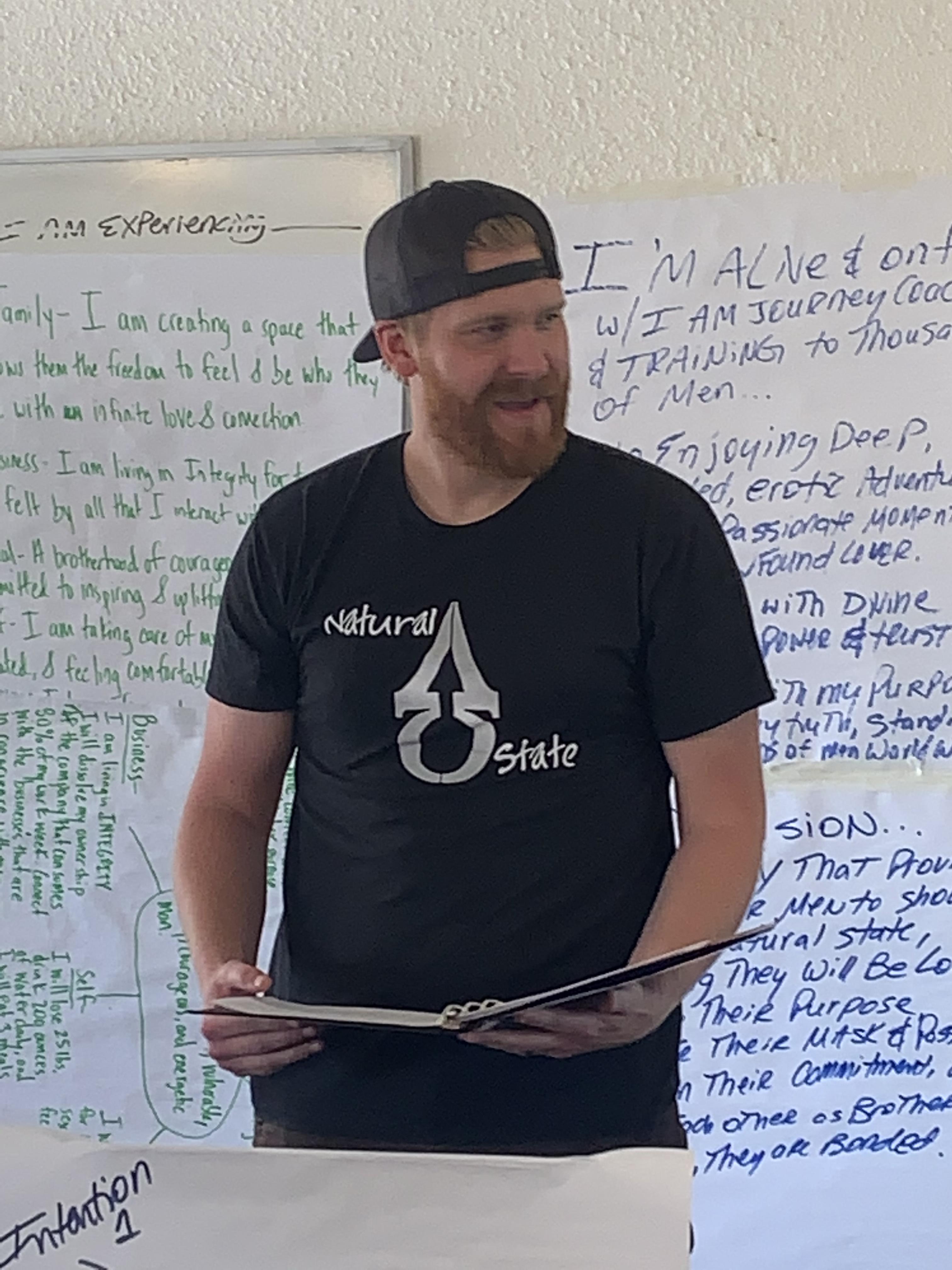
Josh Bishop, mid-share at a Warrior Dad workshop, whiteboard intentions behind him.
“Going in, I was OCD, controlling, and I thought that I was broken. Through the program I found out how to show up in my life and honor my commitments and live in the present with my family — which matters most to me in my life.”
“I no longer have OCD, and I am truly blessed and happy... My son called and said, ‘Thank you for giving me my Dad back.’” — Josh Bishop
Before: ten medications. A marriage where his wife didn't feel truly loved. Two businesses that consumed him. A pattern he was terrified of repeating with his own kids.
After: medication-free. Present. Sold two businesses to become a full-time father. Found, in his own words, his gift — peace.
Josh didn't get a new coping mechanism to replace the old ones. He got his nervous system back. That's the difference this work is actually offering.
Why Psychedelic Medicine, Specifically
Numbing adds another layer between a person and what they're feeling. Talk therapy and medication, valuable as they are, often work at the level of managing that layer — helping someone function around the pain rather than releasing what's underneath it.
Plant medicine works differently. Ceremonial ayahuasca work doesn't ask the nervous system to stay composed and analyze itself from a safe distance — it creates the conditions for the body to finally discharge what it's been holding, sometimes for decades. Clinical research is starting to catch up to what indigenous traditions have known for generations: rapid, significant reductions in depression symptoms have been documented after a single ayahuasca session in controlled trials, and case series work with combat veterans has shown meaningful, lasting reductions in PTSD symptoms.
(See the Ayahuasca Research Hub for full citations.)
This isn't a replacement for medical care. It's a different kind of access — to the root, not just the symptom.
Who This Is For
If you're reading this and quietly recognizing yourself — in the exhaustion, in the ache that won't resolve, in the drink or the scroll or the screen you reach for at the end of a day you can't quite name the weight of — you're not broken. You're a nervous system that's been managing more than it was ever meant to carry, alone, for a long time.
You don't have to have a diagnosis to know something's off. You just have to be honest that “fine” stopped being true a while ago.
The Invitation
This work isn't a cure-all, and it isn't for everyone. But for those who are ready — who have tried “everything else” and are still carrying the weight — there is a different way through. Not another tool to manage the feeling. A way back to the person underneath it.
Josh found his way back. His son got his dad back.
If this is the season you stop numbing and start feeling, we're here when you're ready.
Not another tool to manage the feeling.
A way back to the person underneath it.
Sources: executive mental-health statistic per Raconteur/Gordon Simmons study (2022); clinical citations available in the Soul Journey Ayahuasca Research Hub.
Share This Teaching
About Maestro Sani
Transformational Guide & Founder
For 25 years, I’ve sat in rooms with people from all walks of life, navigating some of the hardest parts of the human experience—facilitating, processing, and holding space for transformation that most environments are not built to handle. My work is grounded in 25 years of transformational mastery and four years of integrating Ayahuasca and plant medicine with success.
That work eventually became something bigger than any one session or conversation could hold. It became the Soul Journey Experience—a structured, complete process built around preparation, deep work, and integration. It is designed for people who are ready to stop circling the same problems and move through them.
I don’t lead with credentials. I lead with experience—and with years of proof that real transformation is not a weekend event. It is a process, and it must be held by someone who has genuinely walked that path themselves.
What that process looks like, and what it asks of the people who enter it, is something I would rather show you than summarize here.